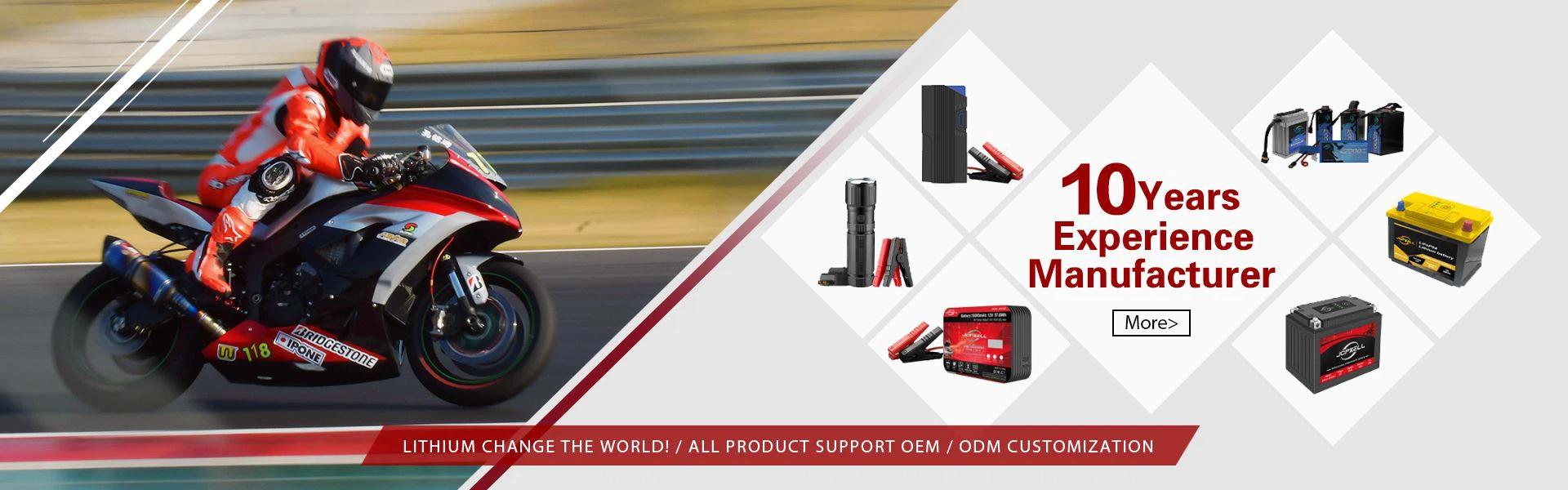
Lithium motorcycle batteries offer several performance advantages over traditional lead-acid batteries, making them a popular choice for modern motorcycles.
Here are the key performance characteristics of lithium motorcycle batteries:
Lightweight design
Weight reduction: Lithium motorcycle batteries are much lighter than traditional lead-acid batteries, typically weighing 1/3 to 1/2 of the weight of lead-acid batteries. This helps to improve the overall performance of the motorcycle, making it lighter, more agile, and easier to handle.
High Energy Density
More Energy, Smaller Size: The energy density of lithium motorcycle batteries is higher, allowing them to store more energy in a smaller volume. This means that a motorcycle can have a longer range without increasing its weight.
Longer Service Life
Extended Battery Life: The service life of a lithium motorcycle battery is usually 5 to 10 years, with a charge and discharge cycle count of around 2,000 to 3,000, while the life of a lead-acid battery is usually only 2-3 years. Lithium motorcycle batteries can withstand deeper discharge cycles, resulting in a longer service life.
Fast Charging
Fast Charging Capability: Lithium motorcycle batteries can charge faster, usually within 30-60 minutes, reaching 80% of their capacity, reducing the waiting time between rides.
Higher Charging Efficiency: Lithium motorcycle batteries have a higher charging acceptance rate, enabling them to convert charging current more efficiently into stored energy.
Low self-discharge rate
Long-term battery life: The self-discharge rate of lithium motorcycle batteries is very low, typically only 1-2% per month. Even if a motorcycle is not used for a long time, the battery can still maintain a high level of charge, making it particularly suitable for seasonal riders.
High output power
Strong starting ability: Lithium motorcycle batteries can provide higher instantaneous currents, making it easier to start a motorcycle, especially in cold weather conditions where they can still provide strong starting power.
Stable voltage output: Lithium motorcycle batteries have a more stable voltage output during use, ensuring that motorcycle electrical systems such as lighting, sensors, etc. operate efficiently.
Maintenance-free
No regular maintenance is required: Lithium motorcycle batteries do not require regular addition of distilled water like lead-acid batteries, and are designed as a fully sealed structure, making them virtually maintenance-free and more convenient to use.
No corrosion: Lithium motorcycle batteries do not leak acid, eliminating the corrosion problem of battery terminals and other motorcycle components.
High Safety
Battery Management System (BMS): Lithium motorcycle batteries are usually equipped with an in-built BMS that monitors temperature, voltage, and current to prevent overcharging, over-discharging, and short-circuiting, thereby enhancing the safety and lifespan of the battery.
Thermal Stability: Lithium motorcycle batteries have better thermal stability, and they do not easily overheat even under high load, thus reducing the risk of fire or explosion.
A wider operating temperature range
Adaptable to extreme environments: Lithium motorcycle batteries can operate normally within a wider temperature range, and they perform particularly well in extremely cold environments, while lead-acid batteries often have difficulty providing sufficient starting current at low temperatures.
Environmental Friendliness
Green Energy: Lithium motorcycle batteries do not contain harmful heavy metals such as lead and sulfuric acid, so they are more environmentally friendly and easier to recycle, with less harm to the environment.
These excellent performance features have made lithium batteries increasingly popular in the motorcycle industry, becoming the preferred configuration for users who pursue high performance, reliability, and environmental friendliness.